
Wakefield Pinders Primary School
Maths

“Everything around you is mathematics, Everything around you is numbers.”
Shakuntala Devi (Human –computer)
Subject Leader: Miss Young Subject Governor: Miss Dianelle Williamson
Maths Statement of Intent
Mathematics makes a considerable contribution to the overall school curriculum and is constantly used in everyday life. The ability to apply it effectively to unfamiliar problems is therefore very important. It is our intent at Pinders Primary for every child to have a sound understanding of Maths, equipping them with the skills of calculation, reasoning and problem-solving that they need in life beyond school. Furthermore, a broad mathematical education is essential for all pupils to equip them to enjoy and to meet the responsibilities of adult life in the world today.
Aims in Teaching Mathematics
We aim:
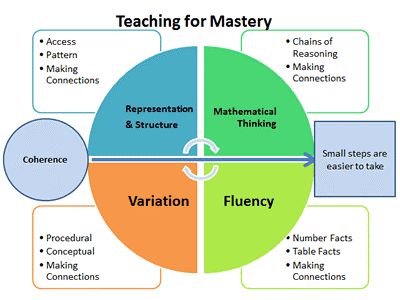
- For all pupils to be taught following the mastery principles and practice of the Concrete, Pictorial, Abstract (CPA) approach.
- For all pupils to become fluent in the fundamentals of mathematics, so that pupils develop conceptual understanding alongside procedural understanding.
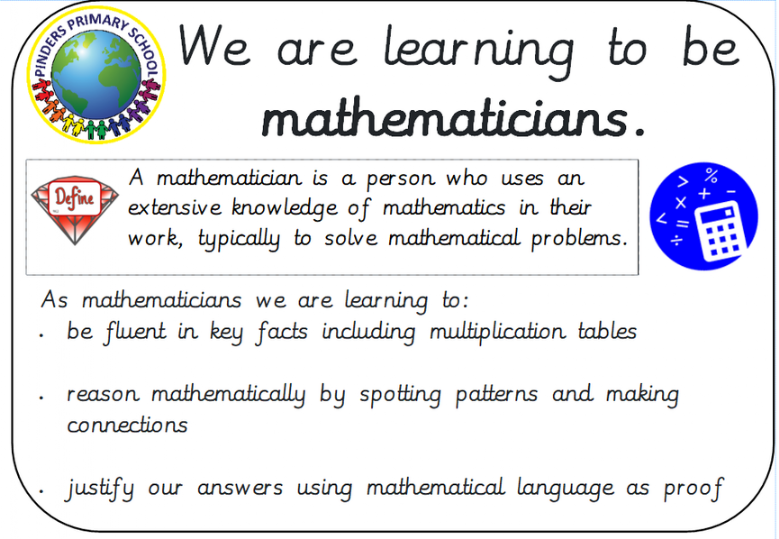
- For all pupils to be quick and efficient in the recall and application of facts and procedures with the flexibility to move between different contexts and representations of mathematics and to gain automaticity with key facts including multiplication tables through the use of interactive games (such as Times Tables Rock Stars and Diamond Dash).
- For all pupils to reason mathematically by spotting patterns, making connections and justifying their answers using mathematical language as proof.
How is the content chosen?
As a school we have adopted the White Rose Maths Mixed Age Curriculum and teach in phases to ensure all children access the same diet of maths. The White Rose curriculum is a cumulative curriculum, so that once a topic is covered it is met many times again in other contexts (especially through the Flash Back 4 starters) which also allows for a clear progression of skills and knowledge to be taught. Furthermore, the long term blocking for each phase is sequenced to ensure children can embed learning through spaced repetition of learning and make connections which leads to a greater depth of and understanding within the subject. We also use variation through representations and procedures taught, they also set out the structure for teacher-led modelling using a range of pictorial representations to support the CPA approach. The curriculum reflects the expectations in the National Curriculum programmes of study and Early Years Foundation Stage (EYFS) framework and engages and inspires our children. The content may also be chosen based upon the needs or interests of specific cohorts or links to events which are taking place in the community or wider world.
National Curriculum Requirements
Implementation - How is the subject taught?
- Early Years
In the Early Years Foundation Stage, maths is taught in practical ways in order to promote social skills and the development of mathematical language and understanding. Child initiated learning opportunities are cross-curricular and children experience a wide range of open-ended problems and resources, both indoors and out. In the EYFS maths is also taught as a discrete subject. The children have daily adult led maths lessons following the mastery number approach. Learning is reinforced through enhancements within the provision areas reflecting the objective that has been taught. Pupils have a weekly lesson in writing their digits with correct orientation and are taught to use squared paper for this. Through AFL pupils who are not secure in the learning are quickly identified and the learning is revisited with an adult.
- Key Stage 1 and Key Stage 2
Maths is taught daily following the agreed sequence of learning (based on the White Rose Education Mixed-Age Schemes of Learning). Lessons begin with the ‘flash back four’ which revisits content from the previous steps, blocks, terms and years. Each step is carefully sequenced to ensure progress is made. Lessons give children the opportunity to practice skills and develop their understanding through taught input, group work and independent activities.
Children in Key Stage 1 also have access to continuous provision and all years groups have access to concrete resources This strengthens and develops their automaticity. The majority of learning is recorded directly into their books using the squared paper, they are taught to set their work out correctly in order to strengthen their understanding of place value. Work sheets are used only when necessary for the mathematical concept being taught or as an adaptation for individual learners. We value good quality presentation and have consistently high expectations for all learners. As a school we have an emphasis on oracy and encourage a ‘no hands up’ approach in maths lessons to boost engagement and ensure children are able to articulate their answers and have the chance to work collaboratively with a partner or a group. Problem Solving opportunities are built into our curriculum.
- Mastering Number
Mastering Number sessions are an integral part of maths learning in Reception, Key Stage 1 and Lower Key Stage 2. Mastering Number has been designed to help ensure that all children are able to develop fluency and flexibility with number that we can describe as ‘good number sense’. Children in year 1 and 2 have four additional maths sessions per week using NCETM Mastering Number programme. The purpose of these additional sessions are to secure firm foundations in the development of good number sense for all children from Reception through to Year 1 and Year 2. The aim over time is that children will leave KS1 with fluency in calculation and a confidence and flexibility with number. Children in year 3 and 4 have five additional maths sessions per week using NCETM Mastering Number programme. This programme enables pupils to develop fluency in multiplication and division facts, and a confidence and flexibility with number that exemplifies good number sense.
Whole School Curriculum Overview
Multiplication Fluency
Diamond Dash
Diamond Dash is a times tables challenge used across school to encourage all pupils to become fluent in their times tables as they progress through school from Early Years to Year 6. There are 8 levels available and these are accessed based on each child’s ability, not their year group. Children are encouraged to take the challenges regularly after practising their skills in school and at home.
About the Multiplication Tables Check
The Multiplication Tables Check (MTC) is a statutory Key Stage 2 assessment to be taken by pupils at the end of Year 4. The MTC is focused on the fluent recall of multiplication facts from the 2 to 12 times tables up to 12 x 12. There will be particular focus on the 6, 7, 8, 9 and 12 multiplication tables as these are determined to be the most difficult.
How the Multiplication Tables Check will be Administered
The MTC will be delivered in school as an online, on-screen digital assessment and will take each pupil less than 5 minutes to complete. There will be a total of 25 questions, worth 1 mark each, and pupils will have 6 seconds to enter their answer to each multiplication recall question.
How You Can Support Your Child at Home
• When practising with your child, focus more on the 6, 7, 8, 9 and 12 multiplication tables.
• When supporting your child, make it fun and exciting by having mini-competitions or playing games.
• The Pixl Times Tables Application can be accessed on any internet-enabled devices (e.g. tablets, mobiles, laptops). The ‘Check’ area is great practise as it tests the children on 25 random questions with a maximum time of 6 seconds per question.
Useful Websites
- https://www.timestables.co.uk - Pupils can access different games and tests for all times tables. This website also has a replica of the MTC, which can be found on the menu.
- https://www.topmarks.co.uk/maths-games/7-11-years/times-tables
- Times Tables songs are available on YouTube or the BBC Super Movers songs which your child will have used in class.
How will the results be reported?
Pupils' individual results will be made available to schools, and the Department for Education will report national results. You will receive your child’s score from school once the data has been received.
If you have any queries or would like support with any of the above, please do not hesitate to ask a member of staff.
Progression of knowledge and skills
At Pinders Primary School we have in place for Mathematics a comprehensive knowledge and skills progression document, which is used for planning, to ensure sequenced and appropriate content for specific year groups, as well as a build-up of knowledge and skills to connect the maths and draw attention to mathematical relationships and structure.
Adaptations
Each class has a class teacher and designated classroom assistants are deployed where needed to support children with additional needs. Where necessary, adaptations will be made to the curriculum, to equipment and to resources to provide access to maths for all pupils. At Pinders we use a pathways approach so all learners can make progress on their appropriate path which meets their individual needs.
Cultural Capital
Cultural capital is the accumulation of knowledge, behaviours, and skills that a child can draw upon and which demonstrates their cultural awareness, knowledge and competence; it is one of the key ingredients a pupil will draw upon to be successful in society, their career and the world of work.
Cultural capital is present in maths through the teaching of concepts with an embedded real-world context. For example, money is taught through the context of buying and selling, and children often have the opportunity to visit our weekly tuck shop to physically spend money. We also host a Primary Futures event which gives the children the experience of being inspired by and exposed to a wide range of careers and job choices. Through our curriculum we build in experiences and knowledge by immersing the children in the world around them and national events so that they develop their sense of self-worth by developing competencies and by playing a positive role in contributing to school life and the wider community.