
Wakefield Pinders Primary School
History

"We are not makers of history, we are made by history"
Martin Luther King Jr
Subject Leader: Mrs Armstrong
Subject Governor: Mr Shab Saleem
Curriculum Intent
History is all around us!
At Pinders Primary School we intend to develop children's experiences and understanding, inspiring and igniting their curiosity about the world in the past, helping them to understand the changes that have occurred over time. As pupils progress, they will learn to think critically, gain knowledge of significant people and events in the past and apply historical skills throughout their learning. Children will understand how the past has influenced the present when learning about the world, its cultures, Britain and our local community.
Children should be able to form opinions based upon fact and understand the necessary changes that have occurred within their lifetime and beyond.
Chronology is a fundamental part of history whereby children learn about significant events and periods, some of which happen concurrently around the world. This helps the children to develop a sense of 'identity' and have a cultural understanding of history.
We aim to nurture children who can think for themselves, form opinions and become independent learners by encouraging them to act upon their own curiosities, seek further knowledge and gain additional information about topics that interest them. Our aim is that, through the carefully planned curriculum we will stimulate the interests of the children and their understanding of the past.
Aims in teaching history at Pinders Primary School:
- To ignite a curiosity in children about the past, including how people lived and how societies have changed.
- To ensure children have a secure knowledge and understanding of key historical events and people from the different periods covered.
- To think critically and be able to form opinions and debate. This will allow them to understand why people interpret historical events in different ways.
- To understand the importance of historical evidence (and sources) and be able to use this to support their own and challenge other viewpoints.
- To enable children to have a voice and see how this has been crucial in the past.
- To love history and see themselves as historians!
How is the content chosen?
Whenever possible, we teach through a themed approach, to enable children to embed learning and make connections which leads to a greater depth of understanding within the subject. Key themes have been chosen to make effective links within topics, across year groups and ensuring they build upon prior learning. The content is ambitious and reflects expectations in the National Curriculum programmes of study and Early Years Foundation Stage (EYFS) framework, which engage and inspire our children. We have also carefully selected topics and themes based on our community, where we live and the interests of our children.
Our History Statutory National Curriculum Programme
EYFS Statutory Framework *Key pages - 10 and 14
National Curriculum- HistoryImplementation
At Pinders Primary School a clear and comprehensive scheme of work in line with the National Curriculum is in place. A two year, long term rolling programme maps out the coverage of the discrete teaching and learning opportunities for children to use and explore different history periods of time, significant people and themes, and develop their historical skills. At our school, we follow the history Programme of Study and have tailored it to meet the needs of our school and community context.
We deliver a carefully planned curriculum which engages children and builds upon prior learning, hopefully creating competent young historians as they continue their educational journey. One way we do this is by providing the children with 'knowledge organisers' which contain key historical information about the topics they are learning in school. These are sent out at the start of each topic and mean that children can share what they are doing with their family and friends.
Progression of Knowledge and Skills
At Pinders Primary School we have a comprehensive knowledge and skills progression document in place for the teaching of History. This is used for planning, to ensure sequenced and appropriate content for specific year groups, as well as a build up of knowledge and skills.
- Allow additional processing time or time for discussion with talking partner prior to the learning.
- Pre-teaching of vocabulary
- Visual prompts and use of widget (dual coding) to give meaning to words to ensure that text is accessible, but not overly ‘simplified’.
- Constructing answers with peers or talking partner
- Use of sentence starters to support writing as a historian
- Use of sentence frames to support writing and communicating as a historian.
- Key vocabulary linked to images and up on wall available.
- Low stakes quizzing and reactivation of prior knowledge opportunities supports learning retention over time.
- Build in practical hands-on learning and experiences (e.g. using artefacts) to allow children to build understanding through context.
Use of chunking to support attention and focus e.g. time to read, time to discuss, time to write but with pictures to support this (dual coding).
Becoming a Historian
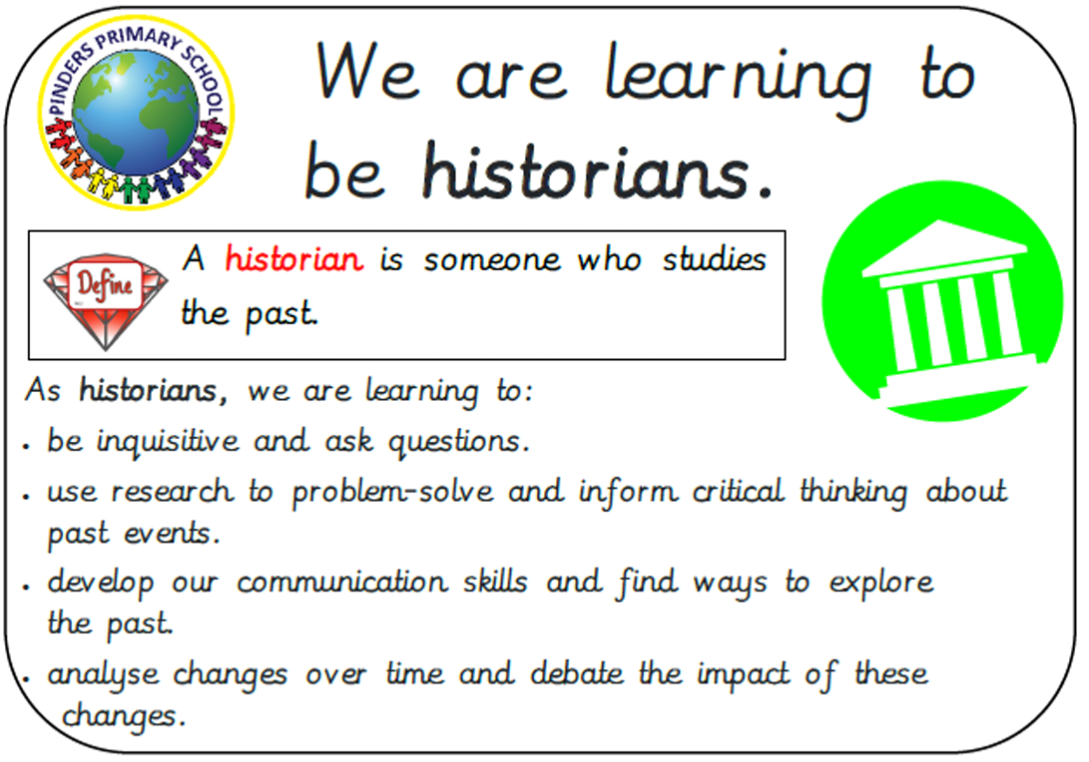
When children are learning about a subject through a discrete teaching session, they are explicitly told that today they are going to be 'historians'. They are then reminded of the key skills that they will learn, use and develop within that subject.
Reading in history
Books are a central part of our history curriculum and most new topics start with a book. Below is an overview of the books embedded within our history curriculum and a rational about they they were chosen.
How do we develop cultural capital in history?
Cultural capital is the accumulation of knowledge, behaviours, and skills that a child can draw upon and which demonstrates their cultural awareness, knowledge and competence; it is one of the key ingredients a pupil will draw upon to be successful in society, their career and the world of work.
In history, we aim to provide children with various opportunities to develop their cultural capital by going on various school visits and having topic-based experiences in school. Many of these are new experiences for most of the children and provide them with hands-on experiences to help them to fully immerse themselves in historical topics and become enthusiastic, engaged and independent learners.


Significant people in History
When planning our curriculum, we highlighted some key significant historians for the children to learn about. These people were chosen for various reasons but are all known for their tremendous impact on history over time!
Curriculum Documentation
Relevant Subject research links
Parent support/links
If you would like to find out more about History at our school, please access our school twitter page @pindersprimary or search the hashtag #PPHistory to find specific history themed tweets!